

A German-made maintenance tool for plate heat exchangers, trusted by professionals worldwide
JUWEL’s torque wrenches for servicing plate heat exchangers are the preferred choice of international manufacturers and service companies. With this plate heat exchanger service tool from Germany, you can open and close plate heat exchangers with over 1,000 plates.
JUWEL since 1980
Owner & CEO: Fabian Berger, 3rd Generation
"It makes me proud every time to see where our plate heat exchangers service tools are being used: whether in New York City, Sydney or Norway. Customers from all over the world trust our equipment from the Westerwald, our home region. JUWEL equipment is the tool of choice for professionals."


Tools for plate heat exchanger maintenance
Opening and closing plate heat exchangers
Plate heat exchangers are regularly opened (dismantled) for service purposes and then closed again (reassembled) to maintain their performance and operational reliability: this includes cleaning, replacing gaskets, inspection, or replacing, adding or removing plates, or carrying out repairs.
With the PHE service torque wrench from JUWEL, manufactured in-house in Germany, plate heat exchangers can be opened and closed for servicing quickly, reliably and easily without any physical effort.
For years, JUWEL has been supporting manufacturers and service companies in the field of plate heat exchangers – worldwide!
JUWEL plays a prominent role in this field, as it is the first brand worldwide to utilise a 4-speed battery solution with 12 Ah batteries. This has taken the work of service companies and plate heat exchanger manufacturers to a new level: plate heat exchangers can be serviced independently, quickly and, above all, safely, without the hassle of cables or hoses.

JUWEL is used on every continent around the world

The major players in Scandinavia and the USA have been relying on JUWEL’s service torque wrenches for plate heat exchangers for years.
Thanks to JUWEL’s in-house manufacturing in Germany, plate heat exchanger service torque wrenches have been developed and extensively field-tested, ensuring they are perfectly suited for daily use: perfectly matched geometries, no cast parts, and only solid, high-strength materials, along with accessories designed to make daily work easier, combine to create the perfect tool.
Close the gap on your competitors: you too can use the service tool that the majority of PHE companies already trust and rely on successfully.
The strongest and most reliable PHE tool for servicing plate heat exchangers is available from JUWEL in Germany. (for opening and closing PHE!)
Variations in service tools for plate heat exchangers
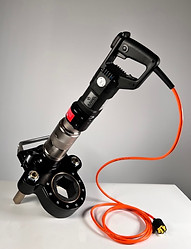
electric torque gun

battery torque gun

pneumatic torque gun
Every customer has specific requirements for their tools. Every service technician working in the field must be regarded as a key figure – the service tool must adapt to the user, not the other way round.
Thanks to our more than 45 years of experience in the field of planetary gearboxes and torque wrenches, we have a wide range of drive options and model classes at our disposal. Together with you and your team, we will find out which tool is right for you. We draw on a wealth of experience and prominent contacts from the world of plate heat exchangers. Benefit from our experience and our network and become a JUWEL customer!
Please get in touch with us!
What are plate heat exchangers?
A plate heat exchanger is a technical device used for heat transfer between two fluids, such as water, oil, steam or coolant. It is used to transfer heat from a hot fluid to a colder one without the two liquids or gases mixing directly with one another.
Plate heat exchangers consist of many thin, profiled metal plates. The media flow alternately through separate channels between these plates. The large surface area of the plates allows heat to be transferred particularly efficiently.

How does a PHE work?
In a plate heat exchanger, two fluids flow past each other in separate channels. The counter-current principle is often used: the hot fluid flows in one direction, whilst the cold fluid flows in the opposite direction. This creates a significant temperature difference over the longest possible distance, which improves heat transfer.
The metal plates transfer heat from the hot fluid to the cold fluid. The media remain separate from one another. This offers clear advantages:
-
High energy efficiency due to a large heat transfer surface area
-
Compact design compared to shell-and-tube heat exchangers
-
Good cleaning and maintenance options, particularly with bolted designs
-
Flexible expandability through the addition of extra plates
-
Small footprint
-
Rapid heat transfer